
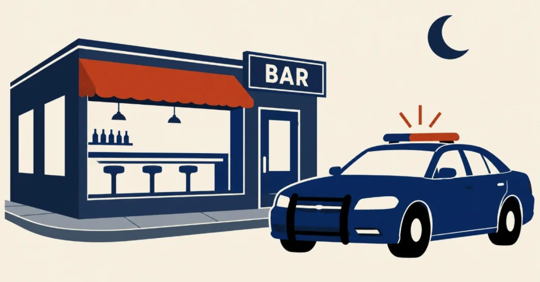
The night before Thanksgiving, often called "Blackout Wednesday," is one of the busiest bar nights of the year in Arizona. Law enforcement agencies across the state respond with saturation patrols, sobriety checkpoints, and task-force operations that continue through New Year's Day. If you are stopped or arrested for DUI during this period, what happens next can affect your driver's license, your freedom, and your future. MayesTelles Attorneys, home of the 602-LAWYERS, walks you through what to expect, the deadlines you cannot afford to miss, and the options that may still be available.
Arizona Thanksgiving DUI Enforcement by the Numbers
Arizona law enforcement reported 214 DUI arrests and 4,184 traffic stops during the Thanksgiving 2025 holiday enforcement period, according to the Governor’s Office of Highway Safety statistics reported by KVOA. By comparison, Arizona officers reported 263 DUI arrests and 7,053 traffic stops during the Thanksgiving 2024 enforcement period.
Even with fewer arrests last year, hundreds of drivers still faced DUI charges over the holiday, so planning a sober ride before you celebrate is the safest choice.
What Happens Immediately After a DUI Arrest
During heightened holiday enforcement, officers may pull you over for minor traffic infractions, set up DUI checkpoints, or respond to accident calls with DUI-trained officers on standby. Once an officer suspects impairment, you can expect:
- Field sobriety tests — standardized exercises such as the walk-and-turn, one-leg stand, and horizontal gaze nystagmus test.
- A request for a chemical test — breath, blood, or both, depending on the circumstances.
- Arrest and booking — if officers believe there is probable cause that you were driving under the influence.
- A temporary driving permit — in many cases, the officer confiscates your license on the spot and issues a permit that is valid for a limited period.
Time-sensitive actions begin the moment you are released. Failing to act quickly can cost you your license even before your court date.
Arizona's Implied Consent Law and Chemical Testing
Under Arizona's implied consent law (A.R.S. § 28-1321), anyone who operates a motor vehicle in the state has already given consent to submit to chemical testing if an officer has reasonable grounds to believe the driver is impaired. Refusing a breath or blood test triggers an automatic 12-month license suspension—separate from any penalty the court may impose for the DUI charge itself.
A few things to keep in mind:
- Refusal does not prevent prosecution. Officers may obtain a warrant for a blood draw.
- The administrative suspension for refusal is independent of the criminal case.
- A first-offense refusal suspension is 12 months; a second refusal within 84 months can mean a longer suspension.
Requesting an MVD Hearing — The 30-Day Deadline
After a DUI arrest in Arizona, you typically have 30 days from the date of the arrest to request an administrative hearing with the Arizona Motor Vehicle Division (MVD). This hearing is your opportunity to challenge the license suspension before it takes effect.
- If you do not request the hearing within 30 days, your suspension begins automatically on the effective date listed on the paperwork the officer gave you.
- The MVD hearing is separate from the criminal court case. A favorable outcome at the hearing does not dismiss the criminal charge, and a conviction in criminal court can trigger its own suspension.
- Preparing for the hearing often requires review of the officer's report, the testing procedures, and the probable-cause basis for the stop.
Missing this deadline is one of the most common and costly mistakes drivers make after a holiday DUI arrest.
Understanding Blood Alcohol Content and DUI Charge Levels
Blood alcohol content (BAC) is the measurement law enforcement uses to determine how much alcohol is in your system. In Arizona, the following BAC thresholds determine the level of DUI charge:
- Impaired to the Slightest Degree DUI — Arizona is one of the few states that charges "impaired to the slightest degree," which means you can face a DUI even if your BAC is below the 0.08% legal limit.
- Regular DUI — BAC of 0.08% or above (or impaired to the slightest degree, even below 0.08%)
- Extreme DUI — BAC of 0.15% or above
- Super Extreme DUI — BAC of 0.20% or above
- Aggravated DUI — certain circumstances such as driving on a suspended license, having a minor passenger under 15, or a third DUI offense within 84 months.

Extreme DUI Penalties in Arizona
Extreme DUI charges carry mandatory minimum penalties that are significantly higher than a standard first-offense DUI. Under A.R.S. § 28-1382, a first-offense extreme DUI conviction can include: azleg
- Minimum 30 consecutive days in jail for a BAC of 0.15% to 0.199%, though a judge may suspend all but 9 days if you install an ignition interlock device for 12 months
- Minimum 45 consecutive days in jail for a BAC of 0.20% or above (often called "super extreme" DUI), though a judge may suspend all but 14 days with a 12-month interlock
- Fines and assessments of at least $2,500, or $2,750 for a BAC of 0.20% or above, plus surcharges and court costs
- Ignition interlock device required on every vehicle you operate, typically for 12 months or longer
- License suspension of at least 90 days
- Mandatory alcohol screening, plus education or treatment if the court requires it
- Mandatory traffic survival school
- Possible community service hours
Second-offense extreme DUI penalties increase substantially and include at least 120 days in jail, or 180 days for a BAC of 0.20% or above, along with at least one year of license revocation. Aggravated DUI is a felony, most often class 4, and can carry up to 3.75 years in prison for someone with no prior felony convictions, with longer sentences for repeat offenders.
How the Court Process Works After a Holiday DUI Arrest
The criminal case follows a separate track from the MVD administrative process. Here is a general overview of the stages you may face:
- Initial appearance or arraignment — You are formally told the charges against you and asked to enter a plea.
- Pre-trial conferences — Your attorney and the prosecutor discuss the case, exchange evidence, and explore possible options.
- Motion hearings — Your attorney may file motions to suppress evidence, challenge the traffic stop, or question testing procedures.
- Plea negotiations — Many DUI cases are resolved through plea agreements, though the terms depend on the facts and the charge level.
- Trial — If no agreement is reached, the case proceeds to trial, where the prosecution must prove every element of the charge beyond a reasonable doubt.
- Sentencing — If convicted, the court imposes penalties based on the offense level, prior history, and other circumstances.
Holiday enforcement operations often generate a large volume of arrests at once, which can affect scheduling and case processing times.
Collateral Consequences Beyond the Courtroom
A DUI conviction in Arizona carries effects that go well beyond fines and jail time:
- Driver's License — A DUI conviction can trigger Arizona DUI license suspension rules, including suspension terms and the possibility of additional requirements before driving privileges can be restored, depending on the facts of the case.
- Employment — Many employers conduct background checks, and certain professional licenses may be affected.
- Insurance — Expect significant increases in auto insurance premiums, and some carriers may drop coverage entirely.
- Criminal record — Arizona does not allow DUI convictions to be "expunged" in the traditional sense, though the state's set-aside statute may offer limited relief after completion of the sentence.
- Immigration — For non-citizens, a DUI conviction can create complications in immigration proceedings, including potential issues with visa renewals, adjustment of status, or removal proceedings. Anyone with immigration concerns should speak with an attorney who understands both criminal defense and immigration law.
- Family and custody — A DUI conviction may be raised in custody or family court proceedings.
How a Defense Attorney Can Help
Every DUI arrest has facts that deserve close examination. An experienced DUI defense attorney may be able to:
- Challenge the legality of the initial traffic stop or checkpoint procedure
- Question the accuracy and administration of field sobriety tests
- Investigate whether breath or blood testing equipment was properly calibrated and maintained
- File motions to suppress improperly obtained evidence
- Negotiate with prosecutors for reduced charges or alternative sentencing where the facts support it
- Represent you at the MVD administrative hearing to protect your driving privileges
Chris Culbert, Managing Attorney of the DUI Division at MayesTelles, brings a former law enforcement perspective to every DUI case. That background means your defense team understands how officers conduct DUI investigations from the inside.
Click image to view post on Instagram

“A holiday DUI arrest deserves the same careful review as an arrest on any other night. We want to understand why the driver was stopped, how the investigation was conducted, and whether the testing supports the allegations. Increased enforcement should not lead someone to assume that an arrest means the outcome is already decided.” -Chris Culbert, Managing Attorney, DUI Division at MayesTelles Attorneys

FAQ's:
What happens after a DUI arrest in Arizona?
After a DUI arrest in Arizona, you are typically booked, given a temporary driving permit, and released with a court date. You have 30 days from the arrest to request an MVD hearing to challenge your license suspension. The criminal case and the administrative license case proceed on separate tracks, and missing the MVD deadline can mean losing your license before you ever see a judge.
Can I refuse a breathalyzer or blood test during a holiday DUI stop?
You can physically refuse, but Arizona's implied consent law means refusal triggers an automatic 12-month driver's license suspension. Law enforcement may also obtain a search warrant for a blood draw, so a refusal does not necessarily prevent the state from gathering evidence of your BAC.
What are the Arizona DUI license suspension rules for a first offense?
A first-offense regular DUI conviction typically carries a 90-day license suspension, with the possibility of a restricted permit after the first 30 days.
What is the difference between extreme DUI and regular DUI in Arizona?
A regular DUI applies when a driver has a BAC of 0.08% or higher or is impaired to the slightest degree. An extreme DUI charge applies at a BAC of 0.15% or above and carries significantly higher mandatory minimum jail time, fines, and interlock requirements. A super extreme DUI at 0.20% or above increases those minimums even further.
How can MayesTelles Attorneys help with my DUI case?
MayesTelles Attorneys offers a free, confidential consultation to review the facts of your arrest, explain your options, and begin building a defense strategy. The firm's DUI team includes former prosecutors and a retired police officer who understand how the state builds its case. Call (602) 714-7900 any time the firm is available, 24/7, including weekends and holidays.

Protect Your Rights This Holiday Season
A DUI arrest during the holiday enforcement period does not have to define your future. Arizona's penalties are serious, but you have rights at every stage from the traffic stop to the MVD hearing to the courtroom. The sooner you act, the more options may remain available.
MayesTelles Attorneys, home of the 602-LAWYERS, has more than 200 years of combined experience and includes former prosecutors and law enforcement on the defense team. If you or someone you care about was arrested for DUI this holiday season, contact MayesTelles Attorneys or call (602) 714-7900 for a free, confidential consultation. The firm is available 24/7, including weekends and holidays.