
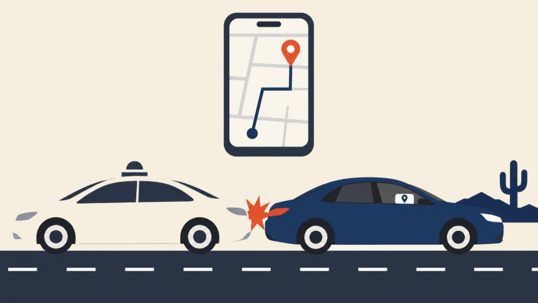
If you were hurt in a rideshare crash, whether you were a passenger in an Uber, Lyft, or Waymo vehicle, or you were struck by one, you may be dealing with pain, medical bills, and confusion about who is responsible. MayesTelles Attorneys, home of the 602-LAWYERS, understands how disorienting an Uber or Lyft accident claim can be, and we want you to know that Arizona law provides a path forward. Below, we break down who may be liable in a rideshare accident, what rideshare insurance coverage for passengers looks like under Arizona statutes, and the practical steps you should take immediately after an accident to protect your rights.
How Rideshare Accident Claims Work in Arizona
A rideshare collision is not the same as a standard two-car crash. When a transportation network company (TNC) such as Uber, Lyft, or Waymo is involved, multiple insurance policies and parties may come into play. Arizona addresses TNC insurance obligations directly in A.R.S. § 28-4038, which sets specific coverage minimums that change depending on the driver's app status at the time of the crash.
The key question is: What was the driver doing on the app when the collision occurred? The answer determines which coverage applies and how much may be available. For a Waymo autonomous vehicle, additional federal reporting rules and the company's own insurance framework may also apply.
Understanding this framework is an important first step if you are considering a personal injury claim.
Who May Be Liable and What Insurance Applies
Multiple parties may share responsibility after a rideshare collision. Who is liable in an Uber accident or in any TNC crash depends on the facts, including the driver's app status, the behavior of other motorists, and the available evidence.
Insurance Coverage by Driver App Status
Under A.R.S. § 28-4038, the minimum insurance requirements change based on the driver's activity:
- Logged in but not matched with a passenger: The TNC driver or company must carry at least $25,000 per person and $50,000 per accident for bodily injury, plus $20,000 for property damage.
- Ride accepted, en route to pick up (before the passenger enters the vehicle): The required coverage increases to at least $250,000 in primary commercial motor-vehicle liability per incident.
- Passenger occupying the vehicle or being transported: Coverage rises to a minimum of $1,000,000 per incident.
Arizona law also requires primary commercial uninsured-motorist coverage during transportation network services in the greater of $25,000 per person and $75,000 per incident, or the applicable minimum bodily-injury limits under A.R.S. § 28-4009.
One detail that catches many people off guard: under the statute, a driver's personal automobile policy is not required to (and often will not) provide coverage while the driver is logged in or providing rideshare services unless the policy expressly says otherwise. This means an injured person may need to pursue the TNC's commercial policy rather than the driver's personal insurance.
“After a rideshare crash, people often assume the driver's insurance will handle everything. In reality, the coverage can depend on details like whether the app was on, whether a ride had been accepted, and whether a passenger had been picked up. Saving your trip information early can make those questions much easier to answer. Additionally, because uninsured/underinsured motorist coverage can be limited in rideshare cases, we always encourage individuals with their own auto insurance to carry uninsured/underinsured coverage.” -J. Blake Mayes, Founding Partner, MayesTelles Attorneys.
Potentially Responsible Parties
- The rideshare driver
- The rideshare company's applicable insurer
- Another motorist whose conduct caused or contributed to the crash
- A vehicle owner (if different from the driver)
- Another entity whose negligence played a role
Arizona follows comparative fault under A.R.S. § 12-2505, meaning that a claimant's recovery is not automatically barred by partial fault. Instead, damages may be reduced in proportion to the injured person's share of fault.
Waymo and Autonomous Vehicles
Waymo is among the companies that have submitted to test autonomous vehicles in Arizona, according to the Arizona Department of Transportation (ADOT). A fully autonomous vehicle may operate on Arizona public roads without a human driver only after meeting specific regulatory requirements, including submission of a law-enforcement interaction plan and written statements addressing federal compliance, insurance, and traffic-law adherence.
If you are injured in a collision involving a Waymo vehicle or another autonomous car, the same general principles apply: identify the at-fault party, preserve evidence, and determine which insurance coverage is available. However, the claims process may involve the autonomous vehicle operator's corporate insurer, manufacturer liability questions, and federal crash-reporting data from NHTSA's Standing General Order rather than a traditional at-fault driver's policy.
Filing a claim against Waymo or another autonomous vehicle operator can involve different evidence channels: vehicle sensor data, telemetry logs, and NHTSA reports that a standard rideshare claim might not.
What to Do After a Rideshare Accident
Knowing what to do after a rideshare accident in Arizona can make a meaningful difference in your ability to pursue a claim. The following steps apply whether you were a passenger, a pedestrian, a cyclist, or someone in another vehicle:
- Call 911 if anyone may be injured. Under A.R.S. § 28-667, law enforcement must complete a written crash report when a collision involves bodily injury, death, property damage exceeding $2,000, or a citation.
- Seek medical attention. Get evaluated even if you feel fine at the scene. NHTSA advises seeking immediate medical care after any crash because some injuries are not immediately apparent.
- Photograph the scene. Capture vehicle positions, damage, road conditions, traffic signals, and any visible injuries.
- Save your rideshare trip information. Screenshot the trip receipt, driver name, vehicle details, route, pickup and drop-off locations, and trip status at the time of the crash.
- Collect witness contact information. Names and phone numbers from bystanders or other involved parties can support your account later.
- Report through the rideshare app. File an incident report through Uber, Lyft, or Waymo's support channel, but understand that an app report does not replace a formal insurance claim.
- Preserve medical records and bills. Keep copies of all treatment records, imaging, prescriptions, and billing statements.
Arizona Deadlines You Need to Know
Arizona generally allows two years to file a lawsuit for personal injury under A.R.S. § 12-542. If the injury leads to death, the limitation period may accrue from the date of death rather than the date of the crash.
This two-year window is a general rule. Claims involving public entities, minors, or other circumstances may have different deadlines or requirements. Missing the applicable deadline can permanently bar your claim.
How an Attorney Can Help With a Rideshare Accident Claim
Rideshare accident claims often involve layered insurance policies, corporate legal teams, and questions about driver status that a traditional car-accident claim does not. The experienced attorneys at MayesTelles Attorneys can:
- Review crash, medical, trip, witness, and insurance information
- Identify which insurance policies may apply based on the driver's app status
Communicate with TNC insurers, corporate representatives, or autonomous vehicle operators on your behalf
- Explain your potential claim options in clear, practical terms
MayesTelles Attorneys has more than 200 years of combined experience and is available 24 hours a day, seven days a week, including weekends and holidays. No attorney can guarantee a specific outcome, but having counsel who understands Arizona rideshare law and TNC insurance structures can help you avoid common mistakes that reduce or eliminate recovery.

FAQ's:
What should I do after an Uber, Lyft, or Waymo crash in Arizona?
Call 911 when anyone may be injured, seek a medical evaluation, and obtain the official crash-report information. Save the rideshare receipt or trip screenshots, photograph the scene and vehicles if safe, collect witness information, and report the incident through the applicable Uber, Lyft, or Waymo support channel. An app report does not replace an insurance claim or a legal deadline.
Does rideshare insurance cover passengers in Arizona?
Arizona law requires at least $1,000,000 in primary commercial motor-vehicle liability coverage per incident when a transportation network passenger is occupying the vehicle. The applicable insurer and available recovery still depend on the crash facts, the driver's app status, fault, policy terms, and whether another driver or party caused the collision.
Who may be responsible for an Uber or Lyft accident in Arizona?
Potentially responsible parties may include the rideshare driver, the rideshare company's applicable insurer, another motorist, a vehicle owner, or another entity whose conduct contributed to the crash. The driver's app status, whether a ride was accepted, whether a passenger was present, and the available evidence help determine which insurance coverage and liability theories may apply.
How is an autonomous Waymo accident claim different from a standard rideshare claim?
A Waymo collision may not involve a human driver, so the claims process often centers on the autonomous vehicle operator's corporate insurer and potential product-liability theories rather than individual driver negligence. Evidence such as vehicle sensor data, telemetry logs, and federal crash-reporting filings may play a larger role than witness testimony or traditional police reports.
How can MayesTelles Attorneys help with an Arizona rideshare accident claim?
MayesTelles Attorneys can review the available crash, medical, trip, witness, and insurance information and explain potential claim options in general terms. An injured person can call MayesTelles Attorneys at (602) 714-7900 for a free, confidential consultation. The applicable deadline and possible recovery depend on the individual facts.

Talk to an Arizona Rideshare Accident Attorney Today
If you or someone you love was hurt in an Uber, Lyft, or Waymo collision in Arizona, you do not have to sort through insurance policies and corporate claims processes alone. Call MayesTelles Attorneys, home of the 602-LAWYERS, at (602) 714-7900 or contact us online for a free, confidential consultation. Time limits apply, so reaching out early gives your attorney the best opportunity to preserve evidence and protect your claim.