
Police finding a substance during an arrest doesn’t end the legal analysis. The State still has to show that officers obtained the evidence lawfully, that the material was properly identified and preserved, and that it can be connected to the person charged. In Phoenix drug cases, that process involves multiple stages, and each one can be tested.
Our attorneys include former prosecutors who understand how the State builds drug cases and where a careful defense review can expose weaknesses in that process.
What It Means to Challenge Drug Evidence
Not every challenge seeks the same result. A motion to suppress asks the court to exclude evidence because officers obtained it in violation of constitutional protections, most often the Fourth Amendment right against unreasonable searches and seizures. An admissibility challenge may focus on laboratory testing, missing records, disclosure problems, or whether the State can establish that the exhibit in court is the same item officers seized.
The central questions are:
- Legality: Did officers have a lawful basis to stop, detain, search, or seize?
- Identity: Can the State prove the seized material was an illegal drug under the applicable statute?
- Reliability: Were the testing methods, records, and witnesses sufficient to support the claimed result?
- Connection: Can the State show the accused knew about and possessed or controlled the substance?
Arizona Revised Statutes section 13-3407 addresses several allegations involving dangerous drugs, including possession, use, sale, manufacture, and transportation. Possession or use is generally classified as a class 4 felony, subject to statutory exceptions and possible alternative treatment in qualifying circumstances. The actual charge depends on the alleged substance and conduct.
Was the Stop or Search Lawful?
The first point in the timeline is often the stop itself. Officers generally need reasonable suspicion, meaning specific facts that reasonably suggest criminal activity, to make an investigative detention. A traffic violation can justify a stop, but the facts matter when police extend that stop or conduct a further search without additional justification.
A review may examine why the vehicle was stopped, what occurred during the initial contact, and whether the detention lasted longer than the circumstances justified. Questions arise when an officer shifts from a traffic matter to investigating suspected drug activity without any new facts supporting that shift.
A drug-sniffing dog can raise its own timeline issues. The question isn’t simply whether a dog was present. It’s when the dog was requested, when it arrived, what prompted the deployment, and whether the stop was lawfully ongoing at that point.
Officers may also search when a person voluntarily consents, but consent can be disputed. A defense review considers who gave permission, what that person was told, whether the scope of consent was limited, and whether officers stayed within it.
When officers rely on a search warrant, the affidavit and the warrant itself become critical records. The affidavit must identify facts supporting probable cause, meaning a reasonable basis to believe evidence of a crime will be found in the identified location. A search can also be challenged if officers searched areas or seized property beyond what the warrant authorized.
Arizona Rule of Criminal Procedure 16.2 governs pretrial motions to suppress. The rule doesn’t mean every police error results in exclusion. A successful motion must identify specific circumstances and give the court a concrete legal and factual basis to evaluate the search or seizure.
Can the State Prove the Substance Was an Illegal Drug?
A field test or an officer’s visual impression may support an arrest decision, but it isn’t the final proof of a substance’s identity. Forensic laboratory testing is typically used to identify the material and determine its reported weight. That laboratory report should be read alongside the police reports and property records, with attention to the submitted item, the amount tested, the method used, the analyst involved, and the result reported.
Testing records may raise questions about:
- Sample Identity: Whether the laboratory received the same item described in the police records
- Testing Scope: Whether the tested portion supports conclusions about all seized material
- Reported Weight: Whether the weight reflects packaging, a sample, or the substance itself
- Drug Classification: Whether the reported substance matches the statute the State charged
- Documentation: Whether the report and supporting records contain discrepancies or omissions
The alleged drug classification affects the charge, the potential sentencing range, and what the State must prove. A lab conclusion should be considered in context, not treated as a substitute for reviewing the entire evidence trail.
Was the Evidence Properly Handled?
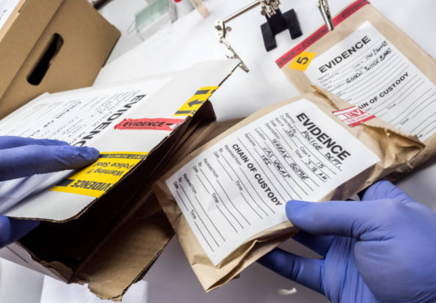
Chain of custody is the documented account of how an evidence item moved from collection to the courtroom. It covers who collected the item, how it was packaged and sealed, where it was stored, who transferred it, what the laboratory received, and how it was maintained afterward.
A chain of custody issue is distinct from an unconstitutional search argument. Even if officers had a lawful basis to seize an item, the State still needs to authenticate it, meaning to show that what’s presented in court is what was seized and hasn’t been altered or confused with another item. Reviewing the records side by side can reveal whether dates, item numbers, weights, descriptions, or seal information are consistent.
Useful records include:
- Property Logs: Records showing when an agency booked the item into evidence
- Evidence Seals: Packaging details that may show whether the item was opened or resealed
- Transfer Records: Documentation of movement between officers, storage locations, and laboratories
- Laboratory Submissions: Forms identifying what was sent for testing
- Photographs & Video: Images or footage showing how the item appeared when collected
- Witness Testimony: Statements from officers, technicians, or evidence handlers about their role
A missing or inconsistent record doesn’t automatically decide a case, but it can affect the weight a factfinder gives the evidence, the foundation required for admission, or the credibility of the State’s account of what happened after seizure.
How the Defense Reviews the Case Before Court
Challenging drug evidence often comes down to reconstructing the sequence of events rather than relying on a single report. Footage may show a different timeline than the written narrative. A dispatch record may clarify why officers were sent to a location. An evidence log may reveal a detail the arrest report omits.
For felony allegations in the Phoenix area, the Maricopa County Superior Court Criminal Department handles hearings and trials. A thorough defense preparation considers both the procedural issues that may be raised before trial and the proof issues that may be tested if the case proceeds further.
Documents should be reviewed together:
- Police Reports: To identify the stated reason for the stop, detention, search, and arrest
- Body Camera Footage: To compare the written account with the actual encounter
- Dispatch & Radio Records: To establish the timing and basis for officer activity
- Warrant Materials: To assess the affidavit, authorized search scope, and return records
- Consent Documentation: To evaluate who consented and what permission was given
- Laboratory Reports: To assess testing, substance identification, and reported weight
- Disclosure & Evidence Logs: To trace items and identify records the State has produced
Inconsistencies may affect whether officers had reasonable suspicion or probable cause, whether a claimed consent search was voluntary, whether the seized material was reliably identified, or whether the State can prove knowing possession. How much any inconsistency matters depends on the surrounding facts and records.
Evidence Challenges Follow the Full Timeline
The fact that officers found suspected drugs doesn’t answer every legal question. The meaningful analysis follows the evidence from the initial encounter through the search, seizure, testing, storage, disclosure, and courtroom presentation. Each stage is a potential point of challenge, and none should be skipped.